 English
 中文简体
 русский
 Español
 عربى

Who We Are

News & Updates

-
01
-
02






Choosing an Industrial Agitator for Chemical Liquid Mixing: A Practical Guide
Content
- 1 Start With the Job, Not the Hardware
- 2 Match the Impeller Geometry to the Flow Pattern You Need
- 3 Get the Shaft Speed and Torque Right
- 4 Choose Wetted Materials and Sealing for the Chemistry
- 5 Check Tank Geometry, Baffles and Mounting
- 6 Do Not Overlook the Motor and the Environment
- 7 Information to Gather Before You Ask for a Quotation
- 8 Think About Support and Spares Before You Order
An industrial agitator is one of those items that is easy to buy and surprisingly hard to buy well. The unit that looks perfectly reasonable on a datasheet can still leave you with a vortex pulling air into the batch, solids parked in a corner of the tank, foam climbing the wall, or a gearbox that runs hot every summer. None of that is bad luck. It usually traces back to a specification that was never pinned down before the purchase order went out.
We have spent many years building mixers for chemical, water treatment, electroplating and dosing duty, and the pattern is consistent: a good selection comes down to five or six questions asked in the right order, and answered with real numbers rather than "roughly the same as last time." This guide walks through those questions in the sequence we normally use with customers.
Start With the Job, Not the Hardware
Before anyone discusses motor power or impeller diameter, be clear about what the agitator has to achieve. "Mixing" covers several quite different duties, and they pull the design in different directions:
- Blending miscible liquids — homogenising density or concentration differences after a charge or a transfer.
- Dissolving solids — bringing crystals, salts or powders into solution without letting them settle into a heel.
- Keeping solids in suspension — just enough agitation to lift particles off the bottom, and not so much that you grind the impeller or entrain air.
- Dispersing a second phase — emulsification, pigment wetting or gas dispersion, which needs high shear rather than high flow.
- Heat transfer — moving liquid across a jacket or coil fast enough that the wall film does not become the bottleneck.
Alongside the duty, record the working volume and the minimum and maximum fill levels. A mixer sized for a full tank can behave very differently at 30% level, and many real complaints come from the low-level case rather than the design point.
Match the Impeller Geometry to the Flow Pattern You Need
Agitator impellers divide broadly into axial-flow and radial-flow types. Axial impellers — pitched-blade turbines and hydrofoil designs — push liquid down to the tank floor and up the walls, producing a strong bulk circulation with modest shear. They are the natural choice for blending, suspension and heat transfer. Radial impellers, such as flat-disc turbines, discharge outward from the impeller and generate high local shear; they suit dispersion duties but are less efficient at bulk turnover.
Three practical rules are worth remembering. First, the impeller-to-tank-diameter ratio typically sits somewhere between 0.3 and 0.5 for axial units, and larger impellers running slowly are generally gentler and more efficient than small impellers running fast. Second, viscous liquids behave very differently from water-like ones: once viscosity climbs, the flow pattern collapses, and you move to close-clearance anchors, helical ribbons or multiple impellers at low speed. Third, always specify viscosity at the actual operating temperature, not at room temperature — a product that is thin when warm can be near-solid in a winter unloading line.
Get the Shaft Speed and Torque Right
Speed and torque are two ends of the same lever. For a given motor power, gearing the shaft down increases the torque available at the impeller, which is what you need for viscous batches, high solids loading and heavy slurries. Two numbers matter more than any other: the running torque and the starting torque, which can be several times higher in a settled slurry or a thixotropic product. Size the shaft and impeller for the starting case, not the running case.
Drive selection follows from that. A cycloidal pinwheel transmission is a common workhorse where high torque at low shaft speed is required and floor space above the tank is tight; our 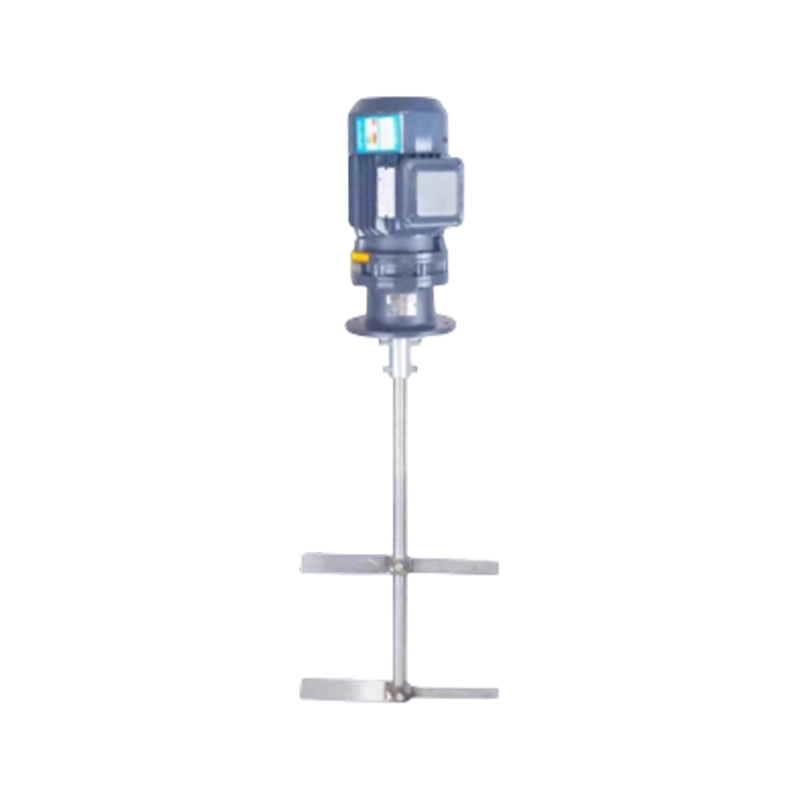 Type BLD Cycloidal Pinwheel Transmission Mixer for High-Torque MixingA compact, high-torque mixer drive for thick, slow-moving batches where low shaft speed and limited headroom matter.View Product → is typical of that approach, and it handles thick, slow-moving batches without a bulky reducer stack.
For more general blending where moderate torque is enough, a straightforward gear-drive unit is easier to maintain and easier to justify; the 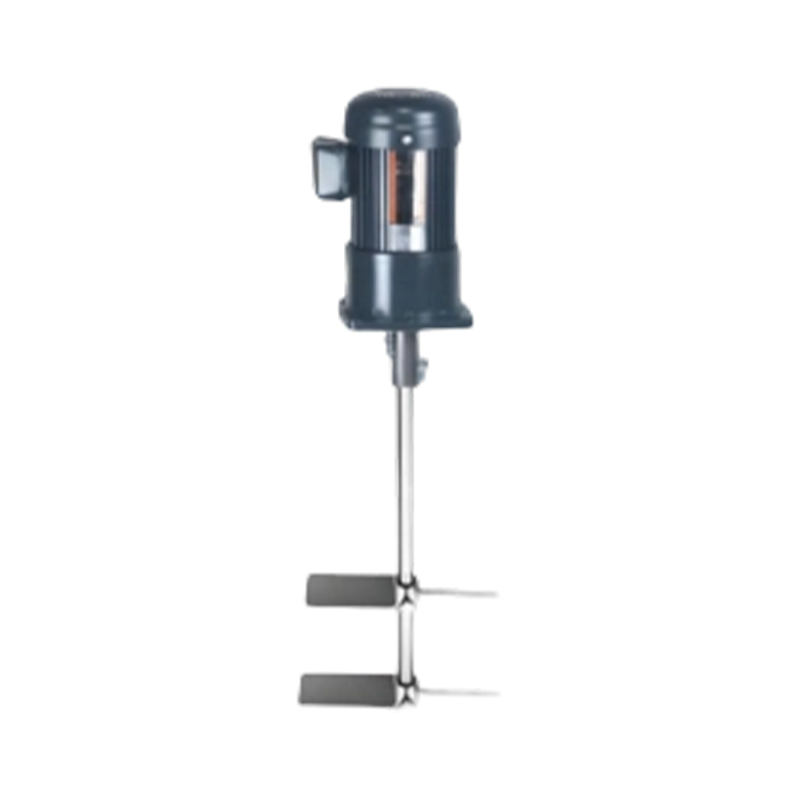 Type CV Gear Drive Mixer for Consistent Pharmaceutical and Food MixingA straightforward gear-drive mixer for standard chemical tanks, with constant-velocity output suited to consistent pharmaceutical and food processes.View Product → is the version most customers start with for standard chemical tanks. The table below sets out how the common drive arrangements tend to line up against real duties.
| Drive arrangement | Where it typically fits | What to check during selection |
|---|---|---|
| Cycloidal pinwheel (BLD) | High-torque, low-speed duty: viscous liquids, slurries, heavy solids loading | Shaft and impeller strength at starting torque, not just running torque |
| Parallel-shaft gear (FF) | General chemical blending in standard vertical tanks | Headroom above the tank and coupling alignment after installation |
| Right-angle shaft gear (KF) | Low-headroom rooms and side-entry configurations | Lubrication orientation and access for seal replacement |
| Coaxial gear (RF) | Compact vertical envelope with moderate duty | Available ratio range against the target shaft speed |
| Gear drive (CV) | Straightforward, easy-to-service general purpose mixing | Service factor when the unit runs continuously rather than in batches |
| Mobile clamp-on (C type) | Drums, IBCs, pilot batches and tanks used on rotation | Clamp rigidity and shaft length against drum depth |
Choose Wetted Materials and Sealing for the Chemistry
Corrosion decides more agitator life than mechanical design does. For neutral or mildly aggressive service, 304 or 316L stainless covers most cases. Chloride-bearing solutions, hypochlorite, acids and plating chemistries usually push you towards PP, PVDF, PTFE-lined or higher-alloy wetted parts. It is worth checking every wetted item, not only the impeller: shaft, coupling bolts, the seal housing and any fasteners inside the tank all see the same vapour.
Sealing deserves its own conversation. A single mechanical seal is adequate for many duties, but crystallising, abrasive or toxic media often justify a double seal with a barrier fluid, or a sealless arrangement. Never assume a seal can run dry. If the tank may be pumped down below the impeller, say so at the enquiry stage — that single detail changes the seal and bearing selection.
Finally, remember that agitation rarely stands alone. Where mixing is one step in a neutralisation, pH correction or flocculation train, it pays to look at the whole sequence together; our chemical mixing and dosing solutions are assembled that way, pairing mixers with metering pumps, dosing skids and control so the stirred volume and the dose rate are designed against each other.
Check Tank Geometry, Baffles and Mounting
An agitator cannot fix a poorly suited tank. Baffles are the usual culprit: without them, a centre-mounted axial impeller simply spins the liquid into a solid-body vortex, wasting energy and pulling air into the batch. Four vertical baffles at roughly one-twelfth of the tank diameter, offset from the wall, are the standard remedy. Where baffles cannot be fitted — small tanks, glass-lined vessels — offset or angled mounting achieves a similar effect.
The mounting interface matters just as much as the hydraulics. Confirm the nozzle size, flange standard, gasket and whether the vessel is open-top or closed and pressure-rated. Check the actual clear height above the tank, because a gearbox that fits in the drawing often does not fit under the pipe rack. For drums, IBCs and small batches spread across several vessels, a portable clamp-on unit is often the most practical answer; the 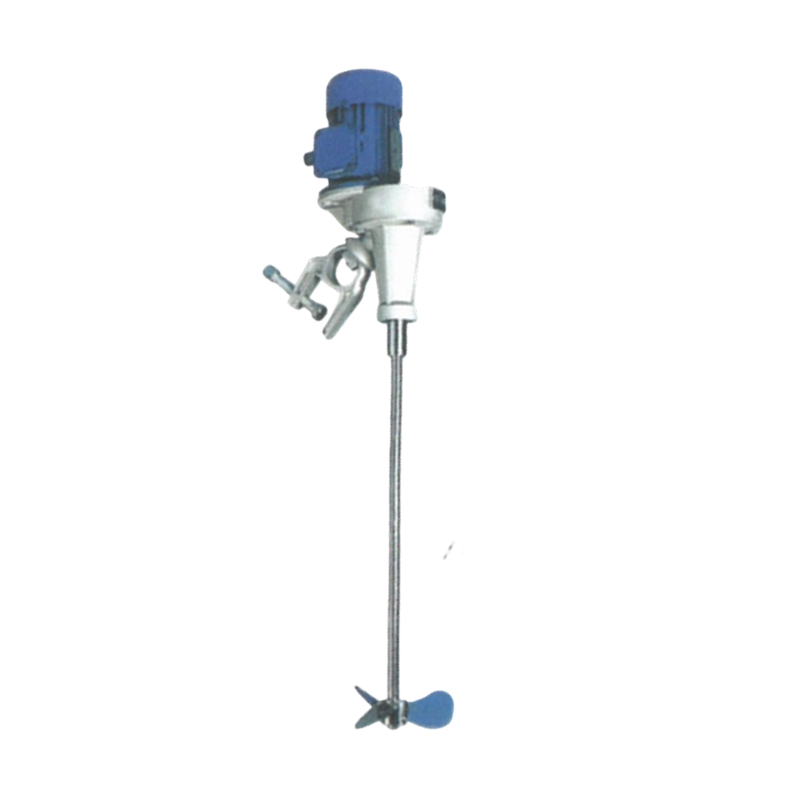 Type C Mobile Mixer for Portable Small-Batch and On-Site MixingA portable, corrosion-resistant mixer for drums, IBCs and small batches spread across multiple vessels, with variable-speed control for changing viscosities.View Product → is built for exactly that kind of moving-target duty.
Do Not Overlook the Motor and the Environment
The impeller tends to get all the attention, but the motor specification is where compliance is won or lost. Confirm the hazardous-area classification, gas group and temperature class if the room is zoned, and confirm the enclosure rating against washdown or outdoor installation. If the process needs turndown — thinning as a reaction proceeds, or gentle start-up of a settled slurry — specify a variable frequency drive from the outset rather than adding it later. Also state ambient temperature, altitude and whether the unit runs continuously, as these all affect the service factor chosen for the gearbox.
Information to Gather Before You Ask for a Quotation
Every round of back-and-forth on a mixer enquiry costs time. A short, complete data set removes most of it. Have the following ready and the selection conversation usually takes a single call:
- Tank diameter, straight-side height and working volume, with minimum and maximum fill levels.
- Product description, density, viscosity at operating temperature and whether the behaviour is Newtonian.
- The primary duty — blend, dissolve, suspend, disperse or heat transfer — and the acceptance criterion for it.
- Solids content, particle size and settling behaviour, if any.
- Operating temperature and pressure, plus any cleaning or sterilisation regime.
- Wetted material preference and the corrosion history of similar equipment on site.
- Mounting arrangement, available headroom, nozzle and flange details.
- Electrical supply, area classification, control philosophy and required turndown.
Think About Support and Spares Before You Order
A mixer is a long-lived item, and the second decade of its life is decided by how easy it is to service. Ask early about seal and bearing availability, shaft removal without dismantling the tank, and whether the drive can be swapped without re-piping. On non-standard vessels, installation and commissioning support are worth more than a marginal price difference — an impeller set at the wrong immersion depth will underperform no matter how good the hardware is.
If you would like a second opinion on an existing installation, or help translating a process description into a specification, our engineers are happy to work through it with you — just get in touch with the details above and we will come back with a recommendation rather than a catalogue page.
Choosing an industrial agitator for chemical liquid mixing is ultimately an exercise in asking complete questions early. Define the duty, pick the flow pattern, size the torque against the worst case, protect the wetted parts from the chemistry, and make sure the tank and the room actually accept the machine you have chosen. Do that, and the agitator becomes the least interesting equipment in the plant — which is exactly what you want it to be.
Launch your project from a free price list tailored to your needs.
Contact Us to Start Your Project.
Through standardized quality inspection procedures, we strictly control every link from raw materials to finished products, ensuring each product meets high-quality requirements.
+86-13861218983 Telephone
+86-13861218983 whatsapp
[email protected] Email
No. 89, Gehu Road, Gaocheng Town, Yixing City, Jiangsu Province, China Factory
Get in TouchCopyright © Jiangsu Syeelai Environmental Technology Co., Ltd. All rights reserved.Wholesale Chemical Transfer and Dosing Equipment Suppliers
