 English
 中文简体
 русский
 Español
 عربى

Who We Are

News & Updates

-
01
-
02


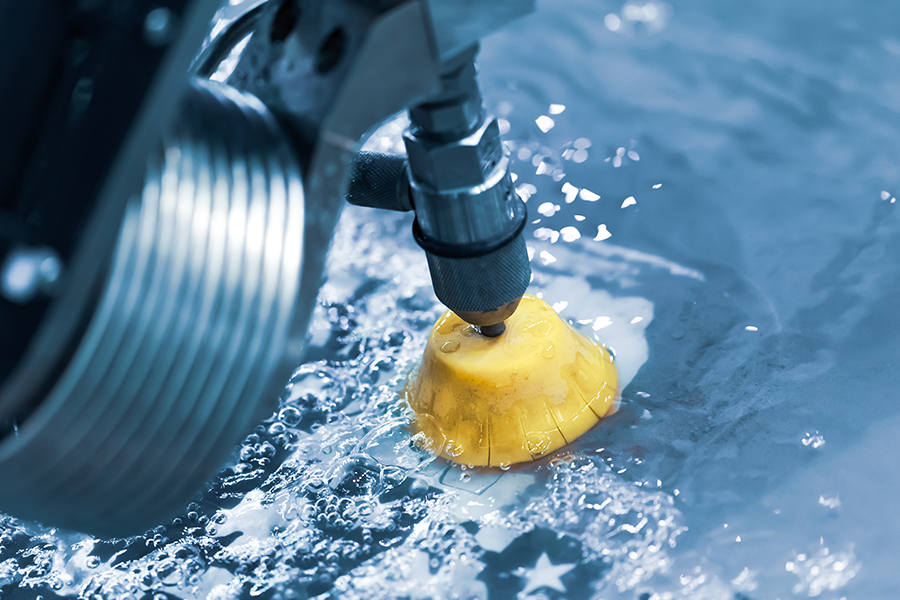




Industrial Liquid Mixer Selection for Chemical Processing: Key Factors
Content
- 1 Define the Mixing Duty Before You Open a Catalogue
- 2 Fluid Properties That Change the Answer
- 3 Tank Geometry, Baffles and Mounting Position
- 4 Drive and Transmission Options in Practice
- 5 Wetted Materials, Sealing and Corrosion Allowance
- 6 Power, Speed and Scale-Up
- 7 When the Mixer Sits Inside a Dosing or Transfer Line
- 8 A Practical Selection Checklist
- 9 Working With a Manufacturer on Non-standard Configurations
A liquid mixer looks like the simplest item on a chemical plant drawing: a shaft, an impeller and a motor on top of a tank. In practice it is one of the few pieces of equipment where a small misjudgement shows up everywhere — in reaction time, in yield, in the suction conditions of the transfer pump downstream, and in how often an operator climbs the platform with a spanner. Most re-selections we are asked to review are not caused by a poor mixer; they are caused by one duty condition that never made it into the brief, such as viscosity at the coldest process temperature, a solid that settles overnight, or a baffle that was specified but never installed.
Define the Mixing Duty Before You Open a Catalogue
Two mixers with identical motors can behave completely differently depending on what the tank is supposed to achieve. Write the duty down in one sentence before looking at models, because it determines impeller type, speed and power far more than tank size does.
- Blending miscible liquids — usually the easiest duty; high-flow impellers at moderate speed.
- Dissolving solids — needs enough flow to wet particles and keep them off the bottom.
- Keeping solids suspended — the critical number is settling velocity, not concentration alone.
- Gas dispersion — requires defined impeller geometry and a known sparge position.
- Heat transfer — wall flow matters more than bulk swirl.
- Emulsification or dispersion — high shear, a different impeller and much higher power input.
A statement such as "blend two low-viscosity reagents in 12 minutes at 40 °C, with no vortex and no foaming" already rules out half the options.
Fluid Properties That Change the Answer
Viscosity and Flow Behaviour
Viscosity is the most common reason a mixer underperforms. Check it at the coldest condition the tank will actually see, not only at ambient, and note whether the product is Newtonian. Thixotropic and shear-thinning fluids can look thin in a sample and behave like a gel after a weekend of standing, and those duties usually call for a slow-speed, high-torque arrangement rather than a fast propeller.
Density, Solids and Shear Sensitivity
Density affects the power drawn at a given speed, and a heavy brine or loaded slurry can shift the motor selection noticeably. Where solids are present, ask for the particle size range, the true and bulk density, and the settling behaviour. Some products — polymer solutions, certain crystallising streams, biological broths — are shear sensitive, and a high-speed impeller that solves a suspension problem can damage the very thing the process is trying to make. Note corrosivity, temperature and any tendency to foam as well, because they also influence how deep the impeller can run.
Tank Geometry, Baffles and Mounting Position
Hydraulics are set by the tank as much as by the mixer. The ratio of liquid depth to tank diameter, the number of baffles, the shaft position relative to the centre line and the impeller-to-bottom clearance all change the flow pattern. Four vertical baffles at roughly one-tenth of the tank diameter are the usual starting point; without them, a centred mixer simply creates a rotating body of liquid that mixes poorly and loads the shaft unnecessarily.
Top entry suits tall process vessels with a dedicated nozzle, while side entry is often the practical answer for large tanks with limited headroom. For drums, IBCs and small batch work, a clamp-mounted unit that moves between vessels is usually more useful than a fixed installation.
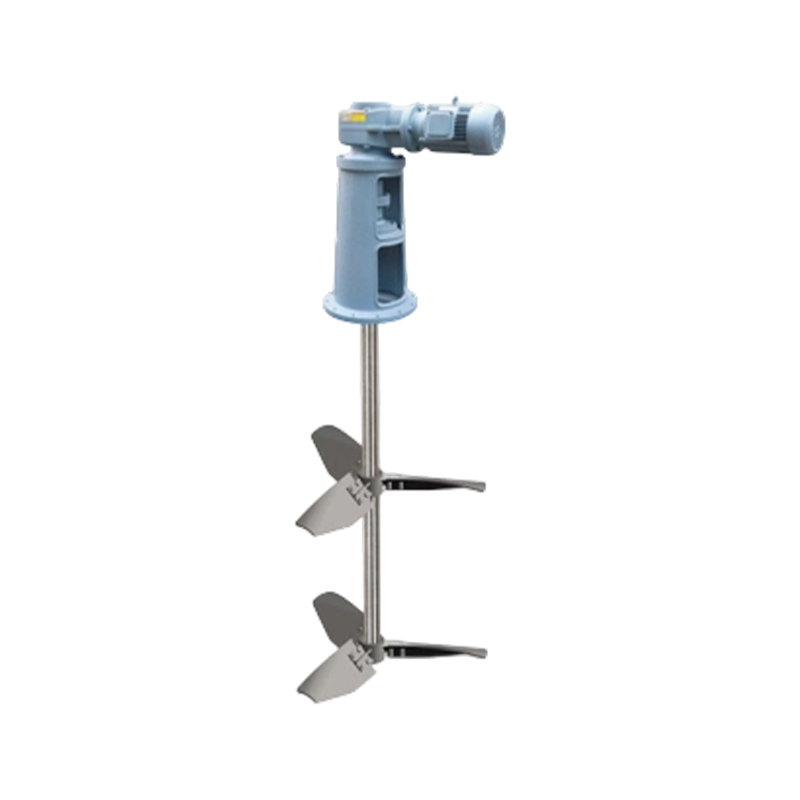
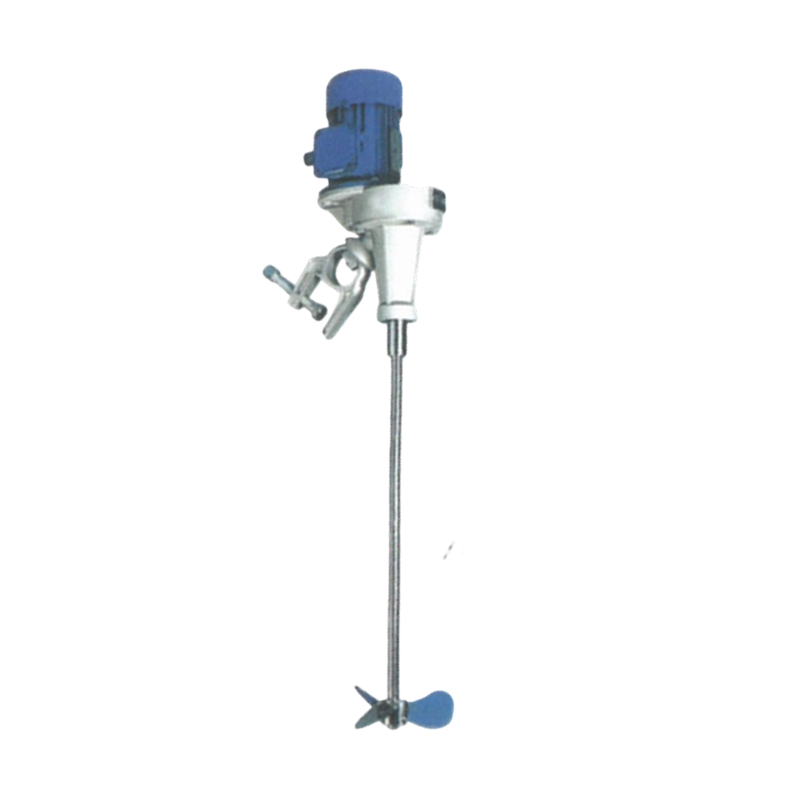 Type C Mobile Clamp-Mounted MixerPortable mixer for drums, IBCs and small batches, with variable-speed drive and quick setup for moving between vessels; confirm shaft length and clamp rigidity.View Product →
With portable units the constraints are shaft length against vessel depth and a clamp that stays rigid at full speed; both are worth confirming before the first batch.
Drive and Transmission Options in Practice
The gearbox and drive configuration decide how the assembly behaves under load, how tall it stands, and how easily it can be serviced. The comparison below is the one we use in early discussions.
| Drive configuration | Where it usually fits | What to confirm before ordering |
|---|---|---|
| Cycloidal pinwheel transmission | Viscous liquids and slurries needing slow speed with high torque | Start-up torque reserve; shaft and bearing load at the impeller |
| Coaxial gear transmission | General blending and dissolution in mid-size tanks with a compact head | Coupling alignment; motor frame; available headroom |
| Parallel-shaft gear transmission | Tall vessels where the motor must sit to one side | Overall ratio against the required impeller speed |
| Right-angle shaft transmission | Low headroom, offset or side-entry installation | Seal arrangement and maintenance access |
| Portable clamp-on unit | Drums, IBCs and short batches with frequent vessel changes | Clamp rigidity and shaft length against vessel depth |
Two configurations cover most of the chemical duties we see. When a batch turns thick, the slow-speed, high-torque characteristic of a cycloidal unit keeps the impeller moving instead of stalling in a gel, which is why we often suggest it for viscous and slurry service.
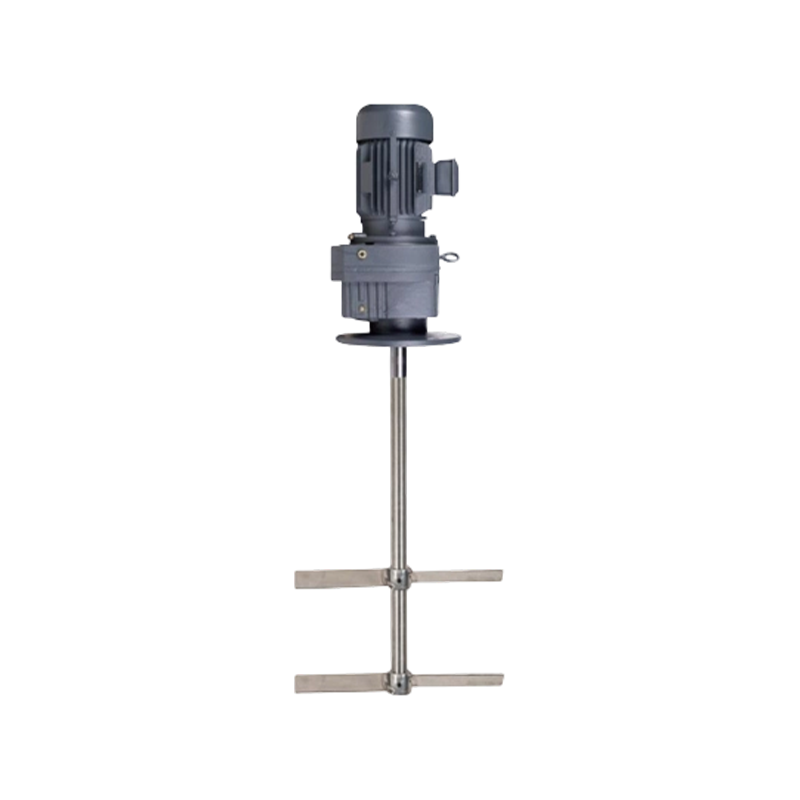
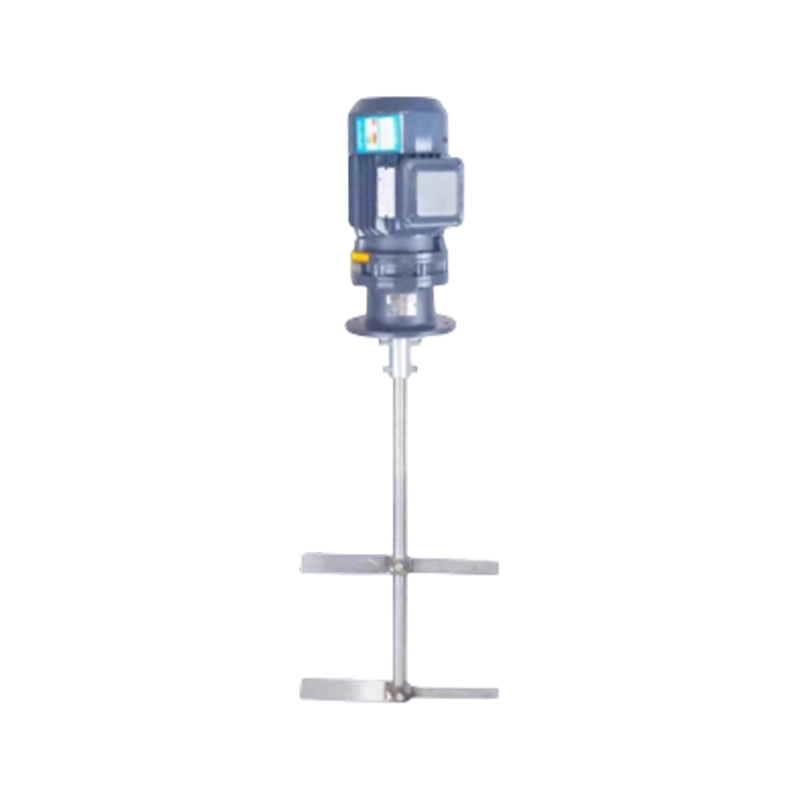 Type BLD Cycloidal Pinwheel Gear Drive MixerHigh-torque, compact cycloidal mixer for viscous and slurry batches, offering high reduction ratios, smooth operation and overload resilience where thick fluids must keep moving.View Product →
Where the duty is a straightforward blend or dissolution in a mid-size tank and headroom is tight, a coaxial gear drive keeps the whole assembly low without sacrificing the torque needed at start-up.
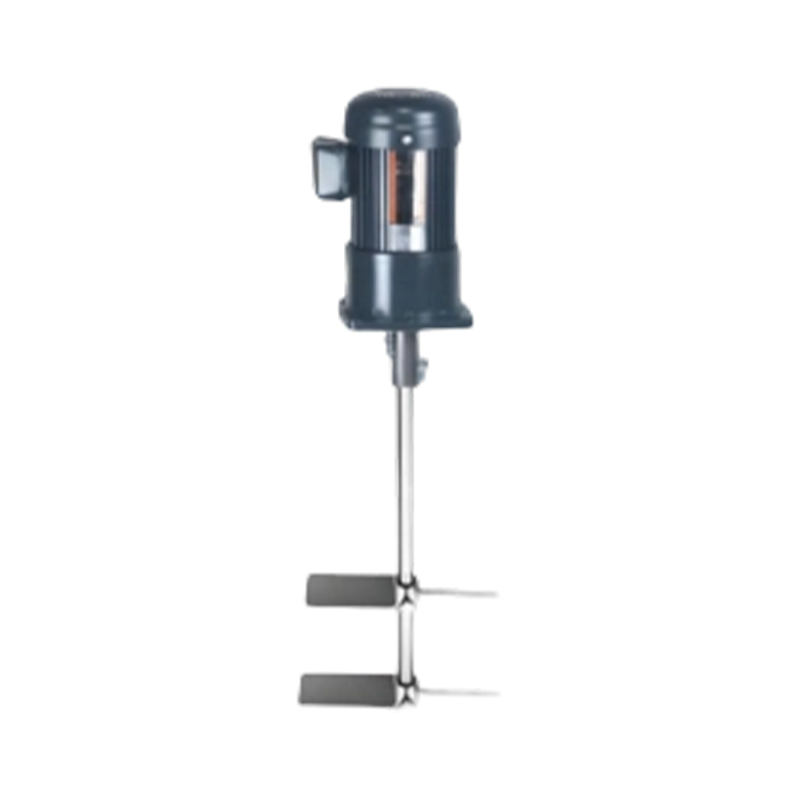 Type CV Gear Drive Mixer for Variable-Load MixingGear-drive mixer for pharmaceutical and food-grade duty, providing constant-velocity output, enhanced sealing and low-maintenance operation where process consistency and leak prevention matter.View Product →
Wetted Materials, Sealing and Corrosion Allowance
In chemical service the wetted path decides service life more than the motor does. Shaft and impeller in stainless steel, coated steel, PP, UPVC or PTFE-lined construction each have a place, and the choice should follow the actual concentration and temperature rather than the generic family name of the chemical. Check gaskets and fasteners at the same time — a corrosion-resistant impeller bolted with the wrong grade of hardware is a maintenance problem waiting to happen.
Sealing comes next. A mechanical seal is normal for solvents and aggressive media, provided it runs wet and is not expected to survive a drained tank. Where leakage is unacceptable, a sealless or magnetically coupled arrangement removes the leak path altogether. Confirm the start-up case too: a mixer switched on with the impeller buried in settled solids sees far higher torque than the running condition suggests.
Power, Speed and Scale-Up
Power input per unit volume and impeller tip speed are the two numbers that travel best between scales. Tip speed governs shear and, in many tanks, the risk of damaging a shear-sensitive product; power per cubic metre governs how quickly the duty is completed. A pilot tank that blends in five minutes will not necessarily do the same at ten times the volume, because geometric similarity is rarely preserved once coils, nozzles and supports are added. Oversizing is not free either: extra installed power costs more, may need a larger nozzle and gearbox, and can create a vortex the process never asked for. A variable frequency drive is often a better investment than additional motor size.
When the Mixer Sits Inside a Dosing or Transfer Line
Many chemical duties are not a standalone tank but one stage in a sequence: prepare, mix, dose, transfer. In those cases the mixer should be selected together with the pump, the dosing point and the pipework, not after them. Flow directed towards the pump suction is helpful; a strong swirl in the wrong direction creates vortexing, air entrainment and unstable metering. Level control, baffles and the position of the dosing lance all interact with the flow pattern.
This is where it pays to look at the mixing stage as part of a wider system, so that mixer, pump and injection point are sized against the same duty. Our chemical mixing and dosing solutions are organised around exactly that idea.
A Practical Selection Checklist
- Write the duty in one sentence, with a completion time and a target result.
- Record viscosity at the lowest and highest process temperature, and whether the fluid is Newtonian.
- List solids with size range, density and settling behaviour; note gas, foam and shear sensitivity.
- Measure tank diameter, liquid depth, baffle arrangement and available headroom.
- Decide mounting: top entry, side entry or portable clamp-on.
- Confirm wetted materials, seal type and start-up conditions, including settled solids.
- Agree impeller speed and power input, and decide whether a VFD belongs in the scope.
- Check the interface with pumps, dosing points and instrumentation before the order is placed.
Working With a Manufacturer on Non-standard Configurations
Chemical plants rarely buy a standard catalogue mixer unchanged. Shaft length, flange size, material of construction, seal arrangement, surface finish and motor protection are usually adjusted per project, and that is the point at which drawings and site conditions need to be checked together. Ask for dimensional drawings, confirm the nozzle and flange standard, and agree who verifies the tank data.
We build corrosion-resistant fluid handling equipment for these duties and support non-standard configurations with installation and commissioning assistance; you can read more about our team and manufacturing background if that context is useful. The main thing is to start from the process condition rather than from a model number — a mixer that genuinely matches the duty is almost always the cheapest one over its service life.
Launch your project from a free price list tailored to your needs.
Contact Us to Start Your Project.
Through standardized quality inspection procedures, we strictly control every link from raw materials to finished products, ensuring each product meets high-quality requirements.
+86-13861218983 Telephone
+86-13861218983 whatsapp
[email protected] Email
No. 89, Gehu Road, Gaocheng Town, Yixing City, Jiangsu Province, China Factory
Get in TouchCopyright © Jiangsu Syeelai Environmental Technology Co., Ltd. All rights reserved.Wholesale Chemical Transfer and Dosing Equipment Suppliers
